Endangered Species Friday: Aquila nipalensis | Wind Farms Pushing Steppe Eagle into Extinction?
Endangered Species Friday: Aquila nipalensis
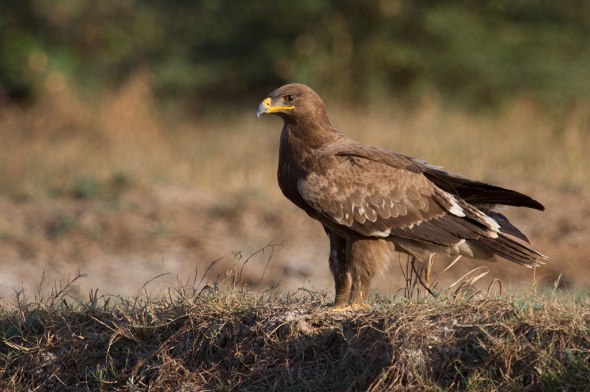
This Fridays (ESP) - Endangered Species Post is dedicated to the A. nipalensis, commonly known as the Steppe Eagle, identified back in 1833. Image credit: Kartik Patel
The Steppe Eagle was formally identified by Dr Brian Houghton Hodgson (1 February 1800 or more likely 1801 – 23 May 1894) was a pioneer naturalist and ethnologist working in India and Nepal where he was a British Resident. He described numerous species of birds and mammals from the Himalayas, and several birds were named after him by others such as Edward Blyth.
Dr Brian H. Hodgson was a scholar of Tibetan Buddhism and wrote extensively on a range of topics relating to linguistics and religion. He was an opponent of the British proposal to introduce English as the official medium of instruction in Indian schools. Had Dr H. Hodgson not introduced English into the many Indian schools, its very likely very few Indian citizens would today know how to speak the English language.
A. nipalensis is listed as (endangered), although its likely the predatory eagle will soon be relisted as (critically endangered), should conservation efforts not improve the current status of this remarkable bird of prey, however this particular bird is somewhat of a mystery.
The major reason why this species is listed as (endangered) which was only recently, is primarily due to wind farming of which birds are reported to fly directly into large structural turbines, which unfortunately, results in their death, or serious injury. Birds that are rescued suffering serious trauma are rarely released back into the wild, or make a full recovery.
From 1988 to 2000 the species was listed as (lower risk). Then from 2003 to 2014 the species remained at (least concern). A risk assessment conducted last year (2015), concluded that the species qualified for (endangered status). Which is somewhat concerning. To date we know the species has already been pushed into regional extinction in the countries identified as; Moldova and Romania. Today the species still remains endemic within the following countries;
Afghanistan; Albania; Armenia; Azerbaijan; Bahrain; Bangladesh; Bhutan; Botswana; Bulgaria; China; Congo; Djibouti; Egypt; Eritrea; Ethiopia; Georgia; Greece; India; Iran, Islamic Republic of; Iraq; Israel; Jordan; Kazakhstan; Kenya; Kuwait; Kyrgyzstan; Lebanon; Malawi; Malaysia; Mongolia; Myanmar; Namibia; Nepal; Oman; Pakistan; Palestinian Territory, Occupied; Qatar; Russian Federation; Rwanda; Saudi Arabia; Singapore; South Africa; South Sudan; Sudan; Swaziland; Syrian Arab Republic; Tajikistan; Tanzania, United Republic of; Thailand; Turkey; Turkmenistan; Uganda; Ukraine; United Arab Emirates; Uzbekistan; Viet Nam; Yemen; Zambia and finally Zimbabwe.
Aquila nipalensis is also a vagrant visitor to most of Northern Europe, Eastern Europe, South East Asia, Southern and Eastern Africa, ranging from Spain; Norway; France; Germany; Finland, Korea; Somalia; Slovakia Etc. Continued rate of decline is (unknown), which is concerning bird lovers and conservationists. Data recorded from the last assessment back in (2015), stated that populations are declining very rapidly.
Population Uncertainty
There seems to have been some perplexing information from the last assessment (before 2015’s) relating to population trend conducted we believe in (2010 or 2012). However the (2015) assessment has confirmed that the current population trend may stand at some: 100,000-499,999 (which is an estimate band or population band). Populations are not known to be (seriously fragmented). Surveys conducted back in (2001) placed the number of pairs at ‘80,000 pairs or 160,000 mature individuals’. Unfortunately the (European population) is estimated to be standing at 800-1,200 pairs in total.
Bird-Life International (2015) estimated that Europe holds the lowest population density standing at some 9%. So a very preliminary estimate of the global population size is 17,800-26,700 mature individuals. A further assessment back in (2001) relating to the European trend stated “160,000 mature individuals was much lower than previously believed”. So as one can see ‘population uncertainty’ is the second likely reason why the species has been re-listed as (endangered). Not forgetting being rather confusing at times too.
Latest Population Assessment Estimate
The latest, and most current population assessment estimate states numbers range (in total) at 31,372 (26,014-36,731) which equates to 62,744 (52,028-73,462) mature individuals or 94,116 (78,042-110,193) individuals. The population is placed in the band 100,000 to 499,999 mature individuals. It must be noted that 100,000 to 499,999 is not the true population count, but more the ‘band that the species currently stands at/qualifies